
Merchant Cash Advances: When Fast Cash Becomes a Financial Trap
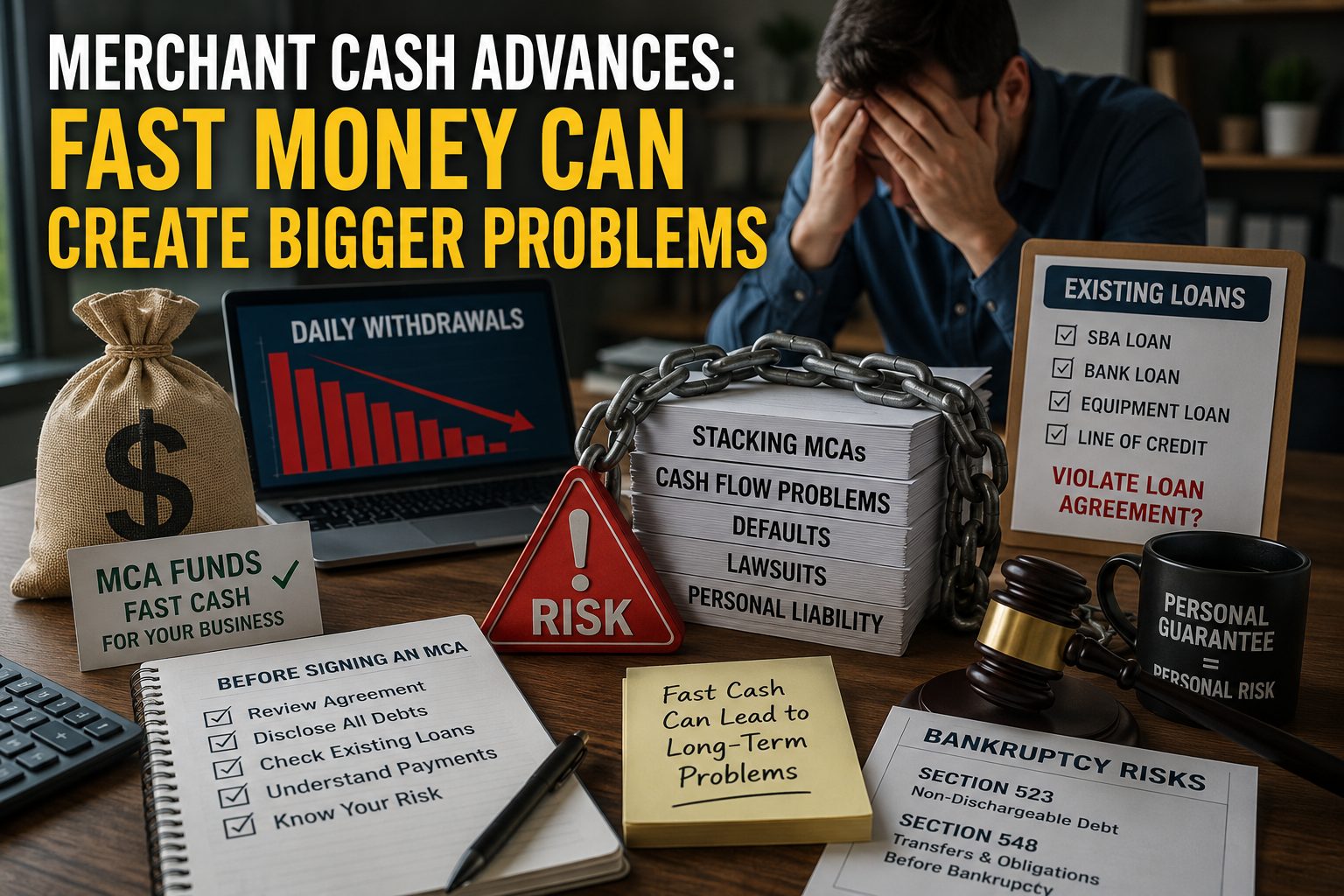 A merchant cash advance, often called an MCA, may look like a quick way to get money for payroll, rent, taxes, inventory, or other business bills.
But a merchant cash advance can create serious financial and legal problems. This is especially true when a business already has an SBA loan, bank loan, equipment loan, or other secured debt.
What Is a Merchant Cash Advance?
A merchant cash advance company gives a business money now. In return, the business agrees to pay back a larger amount from future sales or deposits.
Many MCA companies take payments every day or every week from the business bank account. Those withdrawals can quickly drain the cash needed for payroll, rent, insurance, taxes, vendors, and regular loan payments.
A business owner may believe the MCA is a short-term solution. But it can become a long-term problem.
Is a Merchant Cash Advance Really a Loan?
Many MCA companies say they are not making a loan. They say they are buying a portion of the business’s future sales.
That difference may matter. If the agreement is a true purchase of future receivables, loan and usury laws may apply differently. But the words in the contract are not always the final answer.
A court may look at the real terms of the agreement, including:
- Does the business have to repay the full amount even if sales drop?
- Can the payment actually be reduced when sales are slow?
- Does the MCA company take a real risk if the business fails?
- Are the payments fixed like a normal loan payment?
In Arizona, written agreements may provide for an interest rate different from the usual 10% rate. That can limit usury arguments. But there may still be an important question about whether the MCA is truly a sale of future receivables or is really a loan.
The Danger of Stacking Merchant Cash Advances
“Stacking” means taking out more than one merchant cash advance at the same time.
This often happens when the first MCA payment becomes difficult. The business owner takes another MCA to cover payroll, rent, taxes, or payments on the first MCA. Then the owner may take a third MCA just to keep the business bank account from going negative.
That creates a debt spiral.
When several MCA companies take daily or weekly payments from the same account, the business may not have enough money for ordinary expenses.
Stacking merchant cash advances can lead to:
- Missed payroll, rent, tax, vendor, or insurance payments.
- Overdrafts and bank fees.
- Defaults under several MCA agreements.
- Collection calls and lawsuits.
- Claims that the owner did not disclose earlier MCAs.
- Personal liability under a personal guarantee.
A major warning sign is simple: if a business needs a new MCA to pay an old MCA, the business may be getting deeper into debt instead of solving the problem.
Merchant Cash Advances and SBA Loans
A merchant cash advance can also create problems when the business already has an SBA loan, bank loan, equipment loan, or line of credit.
The existing lender may already have a lien on business assets. Those assets may include accounts receivable, inventory, equipment, deposits, or other business property.
The MCA company may claim rights in some of the same money or assets.
Existing loan documents may prohibit the business from:
- Taking on more debt without permission.
- Giving another creditor rights in the same assets.
- Pledging accounts receivable.
- Taking new financing without written consent.
If the business signs an MCA anyway, it may default under the earlier loan agreement, even if it has made every payment on time.
Before signing an MCA, review all existing loan documents carefully.
Personal Guarantees Can Put the Owner at Risk
Many merchant cash advance agreements include a personal guarantee.
A personal guarantee means the owner may be personally responsible if the business cannot pay. The owner may believe the MCA is only a business debt, but that may not be true.
If the business closes, the MCA company may try to collect from the owner personally.
Merchant Cash Advance Bankruptcy Issues
Bankruptcy may help with some MCA-related debts, especially a personal guarantee. But bankruptcy does not remove every problem.
If the business is a separate LLC or corporation, the business debt is not automatically the owner’s personal debt. But the owner may still be liable if the owner signed a personal guarantee.
Section 523 and Merchant Cash Advances
An MCA company may file a lawsuit in bankruptcy court and argue that the owner’s personal debt should not be discharged.
The MCA company may claim that the owner:
- Submitted false bank statements.
- Lied about income or deposits.
- Failed to disclose other MCAs, liens, loans, or tax debts.
- Provided false information on the MCA application.
- Took new advances without a realistic plan to repay them.
A business failure does not automatically mean fraud. But false statements, hidden debts, or misleading financial information can create serious bankruptcy problems.
Section 548 and Transfers Before Bankruptcy
Section 548 allows a bankruptcy trustee to challenge certain transfers of the debtor’s money or property, or obligations incurred by the debtor, within two years before bankruptcy when the legal requirements are met.
This issue may arise when the person filing bankruptcy personally moved money, transferred property, personally guaranteed new debt, or personally received business funds.
If the business is a separate LLC or corporation, the business’s transfers are not automatically transfers by the owner in the owner’s personal bankruptcy case.
Before bankruptcy, do not move assets, pay relatives, change ownership, or transfer business property to a new company without legal advice.
Before Signing a Merchant Cash Advance
Before signing, review:
- The complete MCA agreement.
- Any personal guarantee.
- ACH withdrawal forms.
- UCC filings or security agreements.
- Existing SBA, bank, equipment-loan, or line-of-credit documents.
- The MCA application and all financial information provided.
Ask these questions:
- How much money will the business receive?
- How much must the business repay?
- How often will payments be taken?
- What happens if sales drop?
- Am I personally responsible?
- Does my existing lender need to approve this MCA?
- Have I fully disclosed all other loans, liens, MCAs, and business debts?
The Bottom Line
A merchant cash advance may provide fast cash, but it can drain the business, create a debt spiral, conflict with existing SBA or bank loans, and expose the owner to personal liability.
Before signing an MCA, understand the full agreement, review existing loan documents, disclose all debts truthfully, and make sure the business can handle the daily or weekly payments.
Every MCA agreement and bankruptcy case depends on its own facts and documents.
Link to my YouTube video


Diane is a well respected Arizona bankruptcy and foreclosure attorney. As a retired law professor, she believes in offering everyone, not just her clients, advice about bankruptcy and Arizona foreclosure laws. Diane is also a mentor to hundreds of Arizona attorneys.
*Important Note from Diane: Everything on this web site is offered for educational purposes only and not intended to provide legal advice, nor create an attorney client relationship between you, me, or the author of any article. Information in this web site should not be used as a substitute for competent legal advice from an attorney familiar with your personal circumstances and licensed to practice law in your state. Make sure to check out their reviews.*




In Case You Missed It

Published On: September 27, 2026
Doing the wrong thing is often easier than doing the right thing. But perhaps that is exactly why honesty, kindness, courage, and responsibility have value. Character is often revealed when the easier choice is available, but we choose the better one.

Published On: September 13, 2026
Paying debt every month but getting nowhere can cost you years of income and thousands of dollars in interest. Before signing up with a debt management or debt settlement company, understand what debts are covered, what fees you may pay, whether creditors can still sue or garnish wages, and whether forgiven debt could create tax problems. For some people, bankruptcy may provide a faster, more complete fresh start and a chance to rebuild.

Published On: September 13, 2026
Thinking About Debt Settlement? Read This Before You Stop Paying Debt settlement may sound like an easier and safer choice than bankruptcy. You have probably seen the ads: “Pay only a fraction of what you [...]
Published On: August 9, 2026
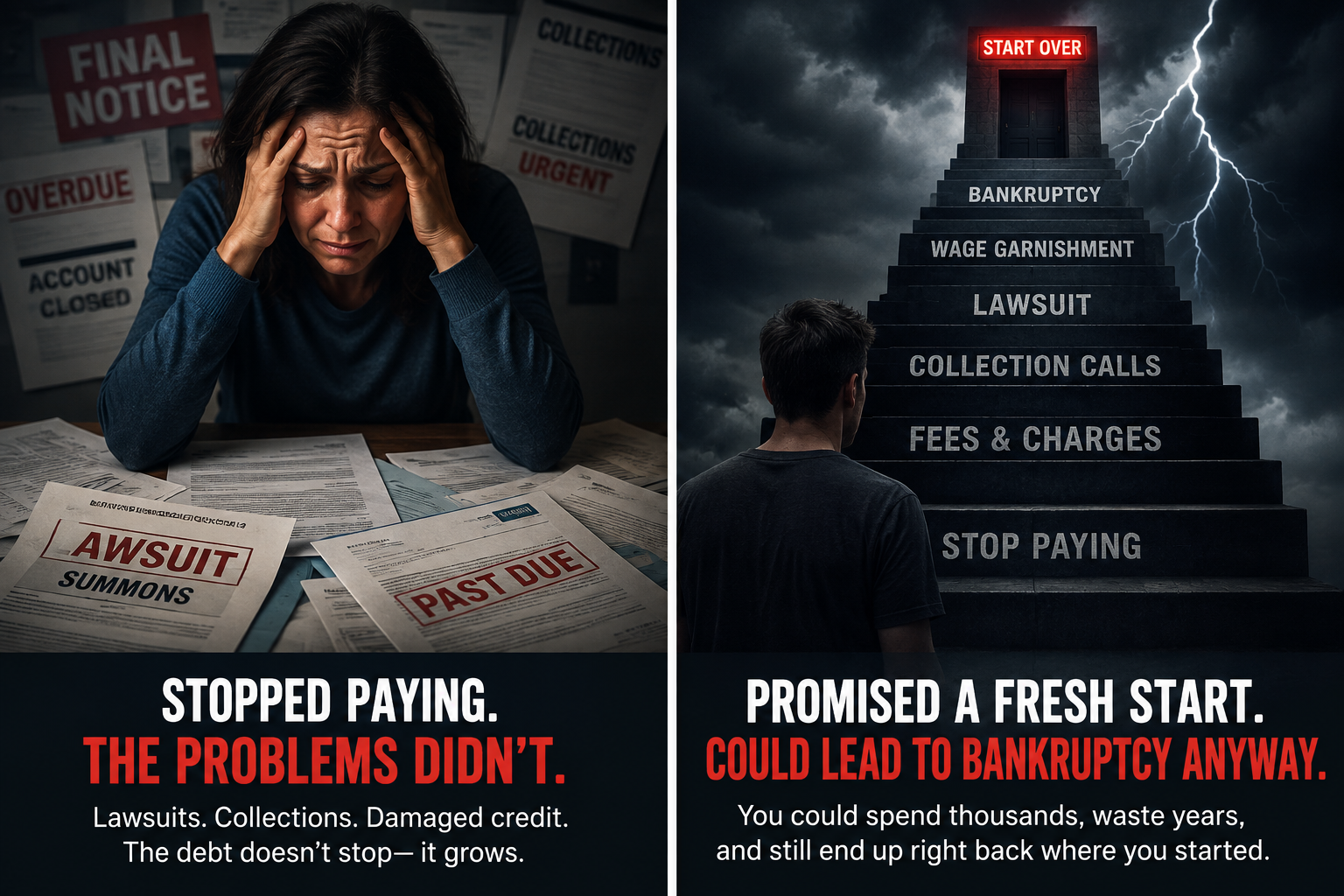
Debt-settlement companies promise to reduce what you owe, but creditors do not have to settle. Learn what federal regulators say about growing balances, lawsuits, fees, taxes and other debt-settlement risks before you stop paying your creditors.