
Bankruptcy Is Not Just Paperwork: Some Simple Mistakes That Can Cost You
For many people, bankruptcy is not the first choice. It is usually something they consider only after they have done everything they know how to do to keep going.
They may have used savings, borrowed from family, worked extra hours, made minimum payments, delayed medical care, put off needed repairs to their vehicles and home, or relied on credit cards for ordinary expenses. Some have even cashed out retirement funds in the hope that one more payment, one more month, or one more sacrifice will solve the problem.
By the time someone begins thinking about bankruptcy, they may be exhausted, frightened, embarrassed, or overwhelmed. They may feel they have failed. They have not.
Key takeaway:
 Bankruptcy can help people who cannot realistically pay their debts. But what you do before filing can make a big difference. Transferring property, repaying family, using credit cards, cashing out retirement funds, or filing Chapter 7 too quickly can create serious problems. Before taking those steps, talk with an experienced bankruptcy attorney who will look at your entire situation, not just collect a fee and rush to file a case.
For many people, bankruptcy is not the first choice. It is usually something they consider only after they have done everything they know how to do to keep going.
They may have used savings, borrowed from family, worked extra hours, made minimum payments, delayed medical care, put off needed repairs, or used credit cards for ordinary expenses. Some have even cashed out retirement funds, hoping that one more payment or one more month will solve the problem.
By the time someone thinks about bankruptcy, they may be tired, scared, embarrassed, or overwhelmed. They may feel they have failed. They have not.
Bankruptcy is a legal tool. It can give eligible people a way to deal with debt they cannot realistically repay. But bankruptcy also requires a complete and honest financial picture. You cannot just list the debts you want to get rid of. You must disclose your creditors, property, income, expenses, and financial history. 11 U.S.C. § 521 (U.S. Code)
YouTube video “Bankruptcy Myths for those Thinking about Bankruptcy“
Is bankruptcy just paperwork?
 No. Bankruptcy is more than paperwork. It is often a difficult decision made by people who have been trying very hard to do the right thing.
The forms are sworn legal documents. They must be accurate. Most individual debtors must complete approved credit counseling before filing and debtor education after filing before a discharge can be entered, unless a limited exception applies.
But the most important decisions often happen before filing. These include transferring property, repaying relatives, taking cash advances, using retirement funds, responding to a lawsuit, or waiting until a foreclosure or garnishment is complete.
The goal should not be to act out of fear, shame, or pressure. The goal should be to understand the options before a decision becomes hard—or impossible—to undo. 11 U.S.C. §§ 109, 521, 727; U.S. Courts provide credit counseling and debtor education guidance. (United States Courts)
Can I transfer property before filing bankruptcy?
 Do not transfer property just because you are thinking about bankruptcy.
When people are afraid of losing something, they may think the safest choice is to put a car, bank account, home interest, or other property in someone else’s name. That reaction is understandable. But it can create very serious problems.
A bankruptcy trustee can challenge some transfers made before bankruptcy. This can include transfers made to delay, hinder, or defraud creditors. It can also include certain payments or transfers to relatives or other “insiders” before filing.
Before changing title, giving property away, selling something important, or moving money, get advice. What feels like a protective step may make things worse. 11 U.S.C. §§ 547 and 548. (U.S. Code)
Do I have to disclose every debt, asset, and financial account?
 Yes. You must list all debts, assets, income, expenses, and financial information.
When someone is under financial pressure, it can be hard to remember every account, debt, asset, possible claim, or past transaction. A small bank account, tax refund, family loan, or old lawsuit may not seem important.
But bankruptcy requires full disclosure. An honest mistake can sometimes be fixed. But hiding property, making a false oath, or leaving out important information on purpose can put the discharge at risk (meaning you can never get rid of those debts).
The safest rule is simple: do not guess what matters. Disclose it and ask questions. 11 U.S.C. §§ 521 and 727 (U.S. Code)
Does it matter which bankruptcy attorney I hire?
 No. Choosing the right attorney matters.
When someone is scared about money, it can be tempting to choose the lawyer with the lowest fee or the fastest promise.
But bankruptcy is not just filling out forms. A careful attorney is one who takes the time to understand your whole situation, including income, property, retirement funds, family payments, taxes, lawsuits, prior filings, and urgent collection risks.
An experienced bankruptcy attorney should explain your options honestly, even when bankruptcy may not be the best answer. The goal should be to protect the client’s long-term financial stability, not simply to collect a fee and file a case quickly.
A person facing financial stress deserves an attorney who listens, asks the right questions, explains the risks, and cares about the person’s future after bankruptcy.
Can I repay family or friends before filing bankruptcy?
 Probably not.
Many people feel they should repay relatives or friends who helped them when they had nowhere else to turn. That feeling is understandable.
But payments to relatives or other insiders before bankruptcy are reviewed by the trustee. In some cases, the trustee may seek to recover certain payments made within one year before filing.
That does not mean every payment to a family member will be recovered. The facts matter. The timing, amount, reason for payment, and available defenses all matter.
Before repaying family, making gifts, or transferring money, get advice. This can help protect the very people you are trying to help. 11 U.S.C. § 547. (U.S. Code)
Should I use my credit cards while I still can?
 Using credit cards for inexpensive basic needs is not always improper. But large charges or cash advances before filing can create significant problems.
When cash is short, credit cards may feel like the only way to buy groceries, pay for gas, or handle a needed repair. Just don’t do it. Use your own money to pay for necessities. Talk to a good attorney who can help you understand the issues that can result in a claim of fraud. A creditor has a right to bring a special lawsuit in your bankruptcy to ask your judge to determine if the debts you incurred in using their credit card or loans were an attempt to defraud, delay or hinder creditors—which can be fraudulent.
The question is not simply whether you were struggling. The question is whether the facts make it look like the debt was incurred fraudulently. 11 U.S.C. § 523 (U.S. Code)
Does bankruptcy eliminate every debt?
No. Bankruptcy can erase many debts, but not all debts.
Some debts may survive bankruptcy. These may include domestic support, some taxes, many government fines or restitution debts, debts based on fraud, and many student loans unless the debtor obtains separate relief.
That does not mean bankruptcy is not helpful. It means you need to know what bankruptcy can fix, what it may not fix, and whether another plan is needed. 11 U.S.C. § 523. (U.S. Code)
If I surrender my car or home, will I owe nothing else?
 Maybe. Giving back property does not always end the debt problem.
Giving up a car or home can be very emotional. It may mean admitting that the payments are no longer possible.
But surrendering property does not always decide whether a creditor has a remaining claim. The answer can depend on the loan papers, the value of the property, the type of bankruptcy, lien rights, and state law.
A bankruptcy discharge usually removes personal liability for discharged debt. But it usually does not, by itself, remove a valid lien against the property. Which means the lender still has a right to repossess your vehicle or foreclose on your home.
Before giving up a home or car, understand what that decision will actually do. 11 U.S.C. § 524. (U.S. Code)
Will I lose everything in Chapter 7?
 No. Bankruptcy does not automatically mean losing everything. Most, if not all, of your property is exempt (protected from your creditors and the bankruptcy trustee).
This fear keeps many people from getting advice early. In Chapter 7, a trustee may sell nonexempt property to pay creditors. But many people have little or no nonexempt property.
What is protected depends on the law that applies, the value of the property, liens, ownership, and the person’s facts.
No one should be told that they will lose everything. But no one should be told that every asset is safe without a careful review. 11 U.S.C. § 522 (United States Courts).
Should I cash out retirement before filing bankruptcy?
 Do not cash out retirement funds without first getting advice.
Many people feel they should use retirement money before even thinking about bankruptcy. They may believe it is more responsible to sacrifice their future than to seek debt relief.
But cashing out retirement funds can leave someone with less security later in life and still not solve the debt problem.
Many retirement funds have strong protection in bankruptcy. But the answer depends on the type of account, the exemption law, whether the funds stay identifiable, and the facts. Arizona also protects many retirement-plan interests, but there are limits, including certain recent contributions.
Cashing out retirement funds can also create tax problems. Some early withdrawals may be taxable and may include an extra tax unless an exception applies. (IRS)
Before withdrawing, borrowing against, or cashing out retirement funds, it is important to determine whether another option may better protect long-term financial security. 11 U.S.C. § 522; A.R.S. § 33-1126; IRS early distribution rules.
Is Chapter 7 always better because it is faster?
 No. Chapter 7 and Chapter 13 solve different problems.
When someone is under pressure, the fastest option can sound like the best option. But faster is not always safer.
Chapter 7 is often used to deal with unsecured debt, but nonexempt property may be at risk. Chapter 13 allows eligible people with regular income to propose a repayment plan, usually lasting three to five years.
Chapter 13 may help some people catch up on a mortgage, deal with car payments, pay priority taxes, or protect nonexempt assets. Chapter 7 may be better for others.
The right choice depends on income, property, debt, goals, and risks. 11 U.S.C. § 522; U.S. Courts Chapter 7 and Chapter 13 bankruptcy basics. (United States Courts)
Can I file Chapter 7 and simply change my mind later?
 Do not assume you can dismiss a Chapter 7 case just because you changed your mind.
A Chapter 7 case is not something to file casually. Once it is filed, a trustee is appointed. A bankruptcy estate is created. The debtor must disclose assets, debts, income, transfers, and other financial information.
A Chapter 7 debtor does not have an automatic right to dismiss the case. Dismissal requires notice, a hearing, and cause. The judge may consider how dismissal would affect creditors and the bankruptcy estate.
This does not mean dismissal is impossible. But a debtor should not assume the judge will allow the case to be dismissed just because the debtor later regrets filing. This is especially true if the trustee has found possible assets or dismissal could hurt creditors.
Chapter 7 can be powerful. It can also be difficult to undo. 11 U.S.C. § 707.
 Will bankruptcy ruin my credit forever?

No. Bankruptcy can affect credit for years, but it does not ruin a financial life forever.
Many people who are thinking about bankruptcy already have late payments, collection accounts, lawsuits, judgments, high-interest debt, or minimum payments they cannot manage.
The better question is often this: Is the current debt making it impossible to rebuild?
For some people, bankruptcy is not the end of their financial future. It is the first real chance to begin rebuilding.
Should I wait until things get worse before getting information?
 Sometimes waiting makes sense. But waiting can also reduce your choices.
People often wait because they hope something will improve. Maybe there will be a better job, a tax refund, help from family, a settlement, or enough time to catch up.
But once a foreclosure, repossession, garnishment, levy, judgment, or transfer is completed, it may be impossible or harder to fix.
Filing bankruptcy usually triggers the automatic stay. The automatic stay can stop many collection actions. But it has exceptions. Creditors can ask the court for relief from the stay. Prior bankruptcy filings can also affect how much protection the stay provides.
Getting advice early does not mean you must file bankruptcy. It simply gives you more time and more choices. 11 U.S.C. § 362. (U.S. Code)
Does filing bankruptcy stop every collection problem forever?
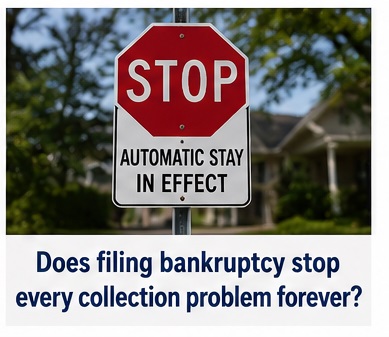 No. The automatic stay is powerful, but it is not unlimited.
The automatic stay can stop many lawsuits, garnishments, collection calls, repossessions, and foreclosure actions. That relief can be very important.
But some actions are not stopped. A creditor may ask the court for permission to continue. Repeat filings can limit the stay in a later case.
In Chapter 13, a debtor usually receives a discharge after completing plan payments. There are limited exceptions, including a possible hardship discharge in some cases. 11 U.S.C. §§ 362 and 1328. (U.S. Code)
Do I have to list a possible lawsuit, inheritance, tax refund, or business interest?
Yes. You should disclose possible claims and property rights, even if you have not received money yet.
Someone may not think of a personal-injury claim, a pre-filing right to a tax refund, a small business interest, or a possible inheritance as an asset. They may not know if anything will ever come from it.
But the bankruptcy estate usually includes legal and property interests the debtor has when the case is filed. It can also include certain inheritances, life insurance proceeds, and property-settlement rights received within 180 days after filing.
The safest approach is to disclose it. The trustee and court can decide whether it is protected, excluded, abandoned, or available for creditors. 11 U.S.C. § 541. (U.S. Code)
Frequently Asked Questions
Can I give property to my children or other close family or friends before filing bankruptcy?
Do not do this without advice. Transfers to family members or friends before bankruptcy can create serious problems. A trustee may review or challenge the transfer.
Should I use retirement savings to pay credit cards before bankruptcy?
Why, won’t you need that for your retirement? Most retirement funds may be protected in bankruptcy. Once the money is withdrawn, it may lose protection and may also create tax problems.
Does bankruptcy erase all debts?
No. Some debts may survive bankruptcy, including certain taxes, domestic support, fraud debts, restitution, and many student loans unless separate relief is granted.
Should I talk to a bankruptcy attorney before making financial changes?
Yes. Talk to an experienced bankruptcy attorney before transferring property, repaying family, using credit cards, cashing out retirement, or allowing a collection action to become final.
Written by Diane L. Drain, Arizona consumer bankruptcy attorney.
As a retired law professor and experienced bankruptcy attorney, Diane focuses on helping people understand their options before making financial decisions that may be difficult to reverse.


Diane is a well respected Arizona bankruptcy and foreclosure attorney. As a retired law professor, she believes in offering everyone, not just her clients, advice about bankruptcy and Arizona foreclosure laws. Diane is also a mentor to hundreds of Arizona attorneys.
*Important Note from Diane: Everything on this web site is offered for educational purposes only and not intended to provide legal advice, nor create an attorney client relationship between you, me, or the author of any article. Information in this web site should not be used as a substitute for competent legal advice from an attorney familiar with your personal circumstances and licensed to practice law in your state. Make sure to check out their reviews.*




In Case You Missed It

Published On: September 27, 2026
Doing the wrong thing is often easier than doing the right thing. But perhaps that is exactly why honesty, kindness, courage, and responsibility have value. Character is often revealed when the easier choice is available, but we choose the better one.

Published On: September 13, 2026
Paying debt every month but getting nowhere can cost you years of income and thousands of dollars in interest. Before signing up with a debt management or debt settlement company, understand what debts are covered, what fees you may pay, whether creditors can still sue or garnish wages, and whether forgiven debt could create tax problems. For some people, bankruptcy may provide a faster, more complete fresh start and a chance to rebuild.

Published On: September 13, 2026
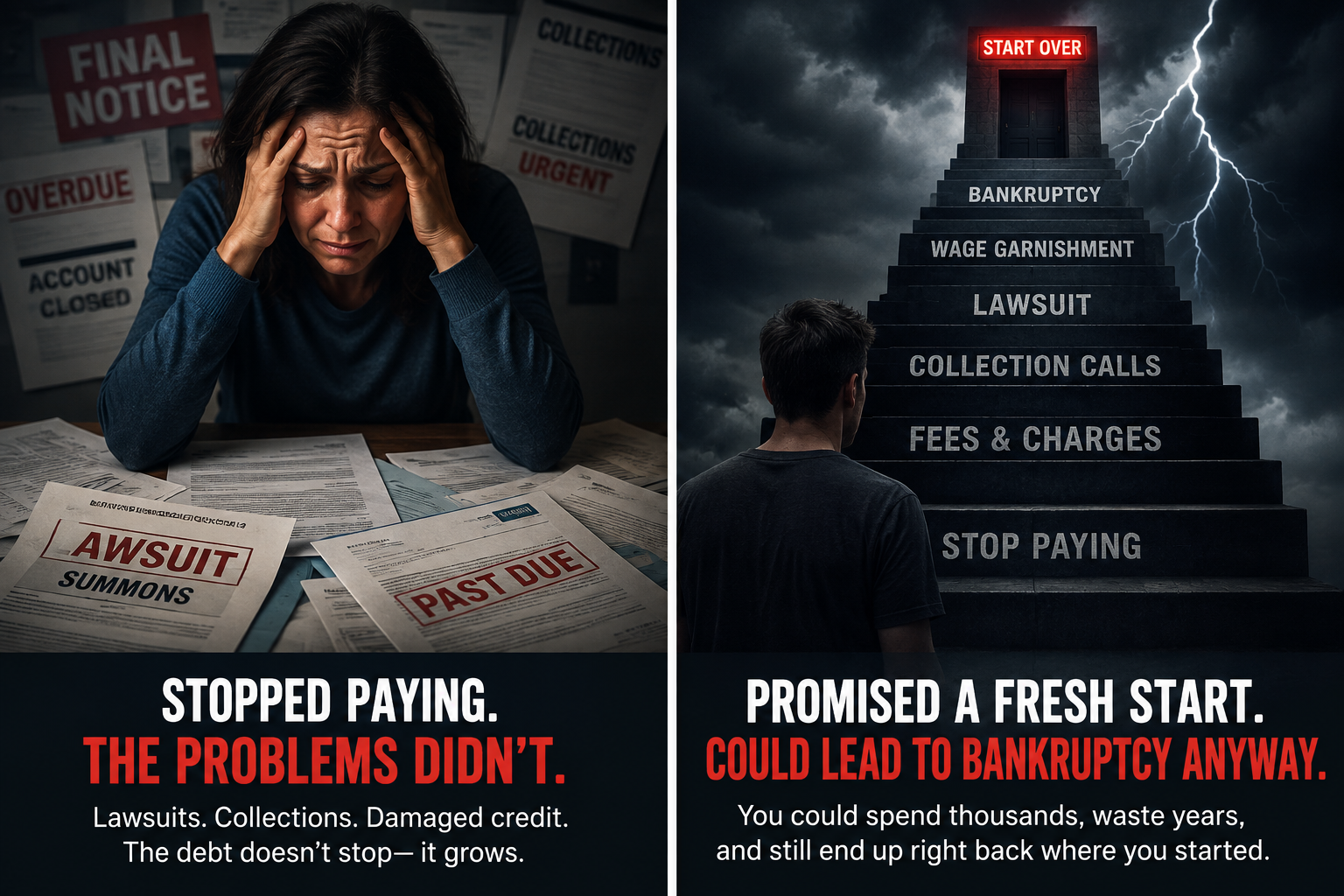
Thinking About Debt Settlement? Read This Before You Stop Paying Debt settlement may sound like an easier and safer choice than bankruptcy. You have probably seen the ads: “Pay only a fraction of what you [...]
Published On: August 9, 2026
Debt-settlement companies promise to reduce what you owe, but creditors do not have to settle. Learn what federal regulators say about growing balances, lawsuits, fees, taxes and other debt-settlement risks before you stop paying your creditors.