
Perils of Filing Bankruptcy by an Undocumented Person or Non-Citizen
This post is based on an earlier post on by Richard J. Parker, (reprinted with permission – December 2017). Updated by Diane Drain: May 2026
Can an undocumented person, non-citizen, or person without a Social Security number file bankruptcy in the United States?
The short answer is yes — immigration status alone does not bar a person from filing bankruptcy. But that does not mean filing is always safe or wise. Bankruptcy is a federal court proceeding. It requires sworn disclosures, identification verification, creditor notice, and sometimes interaction with trustees, the U.S. Trustee, and the court. For someone without secure immigration status, those requirements can create risks outside the normal bankruptcy analysis.
This article discusses the bankruptcy issues. It is not immigration advice. Anyone without secure immigration status should consult an experienced immigration attorney before filing bankruptcy.
1. Bankruptcy eligibility does not depend on citizenship
The Bankruptcy Code does not say that only U.S. citizens may file bankruptcy. Instead, 11 U.S.C. § 109(a) says that a person may be a debtor if the person resides in, has a domicile in, has a place of business in, or has property in the United States. (Legal Information Institute)
That means a non-citizen, including a person who is undocumented, may be eligible to file bankruptcy if the person satisfies § 109(a). The problem is not usually whether the person is “allowed” to file. The real problem is whether filing will expose the person to other legal risks.
2. Bankruptcy requires truthful identification information
Bankruptcy papers are signed under penalty of perjury. A debtor must be truthful about names, addresses, assets, debts, income, transfers, lawsuits, and identifying information.
Federal Rule of Bankruptcy Procedure 1005 requires the bankruptcy petition caption to include the debtor’s name, any employer identification number, the last four digits of the debtor’s Social Security number or individual taxpayer identification number, any other federal taxpayer-identification number, and names used within eight years before filing. (Legal Information Institute)
A debtor must not use a false Social Security number, someone else’s Social Security number, or an invented number. That can create bankruptcy problems and possible non-bankruptcy criminal issues.
3. A debtor may file without an SSN or ITIN, but must be honest
Official Form 121, Statement About Your Social Security Numbers, is used to tell the bankruptcy court about any Social Security numbers or federal Individual Taxpayer Identification Numbers the debtor has used. The official form includes checkboxes for debtors who do not have a Social Security number and/or do not have an ITIN. (United States Courts)
Form 121 also states that it should not be filed as part of the public case file. But that does not mean the information disappears. The form states that full Social Security numbers and ITINs are available to creditors, the U.S. Trustee or bankruptcy administrator, and the case trustee. (United States Courts)
Suggested practice point: Do not guess, borrow, or use an invalid number. If the debtor has no SSN and no ITIN, say so. If the debtor used a number in the past, counsel must carefully evaluate how to disclose that fact and whether bankruptcy should be filed at all before immigration and criminal-law issues are reviewed.
4. Identity verification at the 341 meeting can be a major issue
Every individual debtor must attend a meeting of creditors under 11 U.S.C. § 341. The U.S. Trustee Program states that debtors must provide government-issued photo identification and evidence of Social Security number, or a written statement that the debtor has no Social Security number. (Department of Justice)
For a non-U.S. citizen, acceptable identification may include documents such as a foreign passport, current visa, resident alien card, or identity card issued by a national government authority, depending on the document and current trustee practice. (Department of Justice)
This requirement creates practical problems for some undocumented debtors. A debtor may have foreign government identification, a passport, a visa, or other documentation. Whether the trustee will accept a particular document may depend on current U.S. Trustee guidance and local trustee practice.
Suggested practice point: Before filing, counsel should confirm what identification the debtor has and whether it is likely to satisfy the trustee’s requirements. Do not wait until the 341 meeting to discover there is an identification problem.
5. Bankruptcy is public
Most bankruptcy filings are public federal court records. While full Social Security numbers are protected from public disclosure, the bankruptcy schedules, creditor list, assets, income, address history, lawsuits, transfers, and other information may become part of the public record.
For most people, that public record is simply part of the bankruptcy process. For an undocumented person, public filing may have consequences beyond debt relief. Those consequences may include immigration concerns, employment concerns, tax concerns, or concerns about prior use of identifying documents.
6. Using another person’s identifying information can create serious risks
Federal aggravated identity theft law applies when a person, during and in relation to certain felony offenses, knowingly transfers, possesses, or uses, without lawful authority, a means of identification of another person. (Legal Information Institute)
The Supreme Court held in Flores-Figueroa v. United States that the government must prove the defendant knew the means of identification belonged to another person. (Justia Law) Later, in Dubin v. United States, the Supreme Court narrowed the reach of aggravated identity theft by holding that the use of another person’s means of identification must be at the “crux” of what makes the conduct criminal, not merely incidental to the offense. (Justia Law)
Those cases are important, but they do not make false-number issues harmless. A debtor who has used another person’s SSN, a false SSN, or other questionable identifying documents needs advice from someone qualified to evaluate criminal, tax, employment, and immigration consequences before filing bankruptcy.
Suggested practice point: A bankruptcy attorney should not try to solve the immigration or criminal-law consequences alone. The safer approach is to coordinate with immigration counsel and, where appropriate, criminal defense counsel before filing.
7. Public charge and immigration consequences are unstable areas
Bankruptcy itself is not listed as a public benefit. But immigration consequences can depend on the person’s status, pending applications, grounds of inadmissibility, use of benefits, affidavits of support, and other facts.
DHS’s 2022 final public-charge rule uses a narrower public-charge standard focused on whether the noncitizen is likely to become primarily dependent on the government for subsistence, as shown by public cash assistance for income maintenance or long-term institutionalization at government expense. (Federal Register)
However, DHS issued a November 19, 2025 proposed rule that would remove most of the 2022 public-charge regulatory provisions. Because that is only a proposed rule, it should not be treated as final law. But it does show that public-charge rules remain a moving target. (Federal Register)
Suggested practice point: Do not assume that an old public-charge analysis is still current. Immigration advice should be updated before filing.
8. The I-864 Affidavit of Support may matter
Some immigrants have a sponsor who signed Form I-864, Affidavit of Support. An I-864 Affidavit of Support may be legally enforceable against the sponsor, including support obligations and possible reimbursement obligations for certain means-tested public benefits. (Legal Information Institute)
A bankruptcy filing by the immigrant may not eliminate the sponsor’s obligations, and the sponsor’s obligations may affect family or immigration strategy. This is not a bankruptcy-only issue.
Suggested practice point: If the debtor has a sponsor, or if a family member signed immigration sponsorship papers, immigration counsel should review the I-864 issue before bankruptcy is filed.
9. Exemptions depend on domicile and residency, not citizenship alone
A debtor’s right to protect property in bankruptcy depends on exemption law. In Arizona, residents generally use Arizona exemptions because Arizona has opted out of the federal bankruptcy exemptions for Arizona residents. A.R.S. § 33-1133(B) states that residents of Arizona are not entitled to the federal exemptions under 11 U.S.C. § 522(d). (Arizona Legislature)
But exemption analysis is not the same as immigration analysis. The key questions are usually where the debtor has lived, for how long, and which exemption law applies under 11 U.S.C. § 522. In In re Wood, the Arizona bankruptcy court addressed Arizona’s opt-out statute and concluded that Arizona’s opt-out applied to Arizona residents, not non-residents who were required by federal bankruptcy law to look to Arizona exemption law. (Eighth Circuit Court)
Suggested practice point: Do not assume “non-citizen” means “no exemptions.” Also do not assume that filing in Arizona automatically means Arizona exemptions apply. Residency, domicile, timing, and prior residence must be reviewed carefully.
10. Creditor notice must be accurate, but personal information must be protected
A debtor must list all creditors using accurate names and addresses. Section 342 of the Bankruptcy Code governs notice. Section 342(c) requires certain debtor notices to creditors to include the debtor’s name, address, and last four digits of the debtor’s taxpayer-identification number. If the notice adds a creditor to the schedules, the full taxpayer-identification number must be included in the notice sent to that creditor, but only the last four digits should be included in the copy filed with the court. (U.S. Code)
Section 342(c)(2)(A) separately requires an account number only when the creditor supplied the current account number and the creditor’s requested notice address in at least two communications within 90 days before the bankruptcy filing. (U.S. Code)
This matters because some undocumented debtors may have used different names, different mailing addresses, or different identifying information. The debtor and counsel must make sure creditors receive proper notice without improperly disclosing protected personal information.
Suggested practice point: List all known debts and use accurate creditor information, but do not put full SSNs, full account numbers, debit-card numbers, expiration dates, CVV/CVC codes, or other protected personal information into public filings unless a specific rule requires it and the filing is properly protected or redacted.
11. Bankruptcy may help with debt, but it does not fix immigration problems
Bankruptcy can discharge many ordinary debts, stop collection, stop garnishments, and help a debtor reorganize. But bankruptcy does not create lawful immigration status, cure document issues, erase immigration history, or prevent immigration enforcement.
For some debtors, bankruptcy may still be the right choice. For others, the risks may outweigh the benefit. The answer depends on the debtor’s immigration status, type of debt, identification history, assets, income, family situation, pending immigration applications, and exposure to other legal issues.
Practical checklist before filing bankruptcy for an undocumented person
Before filing, the debtor and bankruptcy attorney should review:
- Does the debtor satisfy 11 U.S.C. § 109(a)?
- What identification documents does the debtor have?
- Does the debtor have an SSN, ITIN, neither, or a history of using another number?
- Has the debtor ever used a false SSN or someone else’s SSN?
- Are tax returns required, missing, or filed under an ITIN?
- Will the trustee accept the debtor’s identification at the 341 meeting?
- Is there any pending immigration application, removal issue, asylum claim, visa issue, green card application, or naturalization concern?
- Did anyone sign an I-864 Affidavit of Support?
- Which exemption law applies?
- Will bankruptcy create risks that outweigh the benefit of discharging debt?
Final thoughts
An undocumented person or non-citizen may be eligible to file bankruptcy. The Bankruptcy Code does not require U.S. citizenship. But eligibility is only the first question.
The more important question is whether filing bankruptcy is safe, accurate, and strategically wise under the debtor’s full circumstances. Because bankruptcy is a sworn federal court process, a debtor with immigration, identification, tax, or document concerns should get advice before filing — not after the case is already in motion.
Suggested legal advice: If the debtor lacks secure immigration status, has no SSN, has used an ITIN, or has ever used a questionable identifying number, bankruptcy counsel should require a pre-filing consultation with immigration counsel and, where appropriate, criminal-law counsel. The bankruptcy case should not be filed until those issues are reviewed.


Diane is a well respected Arizona bankruptcy and foreclosure attorney. As a retired law professor, she believes in offering everyone, not just her clients, advice about bankruptcy and Arizona foreclosure laws. Diane is also a mentor to hundreds of Arizona attorneys.
*Important Note from Diane: Everything on this web site is offered for educational purposes only and not intended to provide legal advice, nor create an attorney client relationship between you, me, or the author of any article. Information in this web site should not be used as a substitute for competent legal advice from an attorney familiar with your personal circumstances and licensed to practice law in your state. Make sure to check out their reviews.*




In Case You Missed It

Published On: September 27, 2026
Doing the wrong thing is often easier than doing the right thing. But perhaps that is exactly why honesty, kindness, courage, and responsibility have value. Character is often revealed when the easier choice is available, but we choose the better one.

Published On: September 13, 2026
Paying debt every month but getting nowhere can cost you years of income and thousands of dollars in interest. Before signing up with a debt management or debt settlement company, understand what debts are covered, what fees you may pay, whether creditors can still sue or garnish wages, and whether forgiven debt could create tax problems. For some people, bankruptcy may provide a faster, more complete fresh start and a chance to rebuild.

Published On: September 13, 2026
Thinking About Debt Settlement? Read This Before You Stop Paying Debt settlement may sound like an easier and safer choice than bankruptcy. You have probably seen the ads: “Pay only a fraction of what you [...]
Published On: August 9, 2026
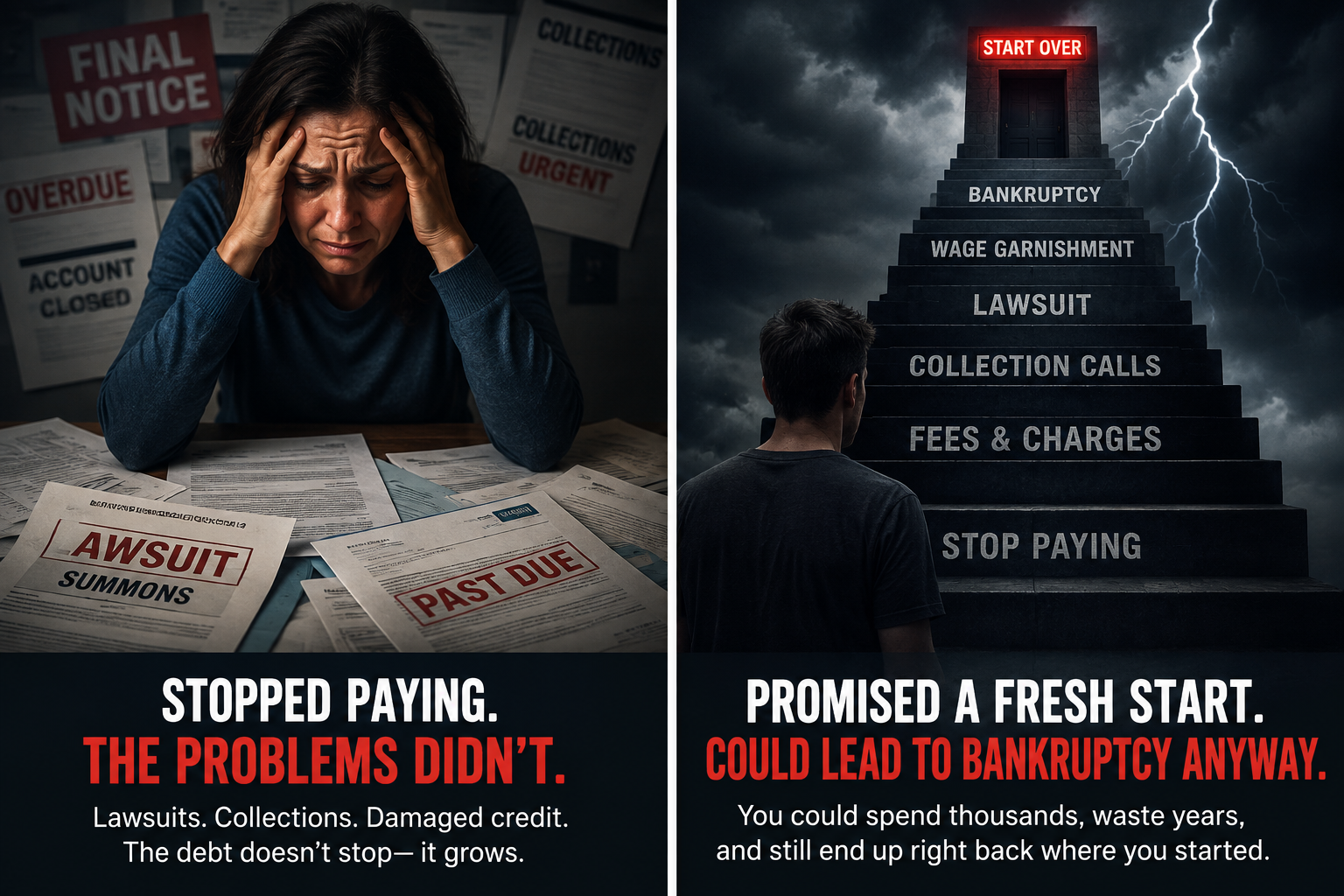
Debt-settlement companies promise to reduce what you owe, but creditors do not have to settle. Learn what federal regulators say about growing balances, lawsuits, fees, taxes and other debt-settlement risks before you stop paying your creditors.